 Separare le particelle senza alterare il prodotto è possibile con i vagli a nutazione TVS di Vaapro che riprendono il gesto del setaccio manuale traducendolo in un movimento regolabile su scala industriale
Nella vagliatura industriale, separare le particelle per dimensione è solo una parte del processo. L’altra è farlo senza alterare il prodotto, soprattutto quando si trattano polveri fini, granuli friabili o materiali leggeri. I vagli a nutazione TVS di Vaapro affrontano questa doppia esigenza riprendendo il gesto del setaccio manuale e traducendolo in un movimento regolabile su scala industriale.
Un movimento che accompagna il prodotto
La nutazione combina un’oscillazione circolare con una lieve componente verticale. Il moto tridimensionale fa rotolare il materiale sulla rete e lo distribuisce sulla superficie vagliante. Regolando la velocità di rotazione e l’inclinazione del corpo macchina, si può intervenire sul tempo di permanenza del prodotto sul piano. L’obiettivo è dare alle particelle più fini il tempo di incontrare un’apertura utile, limitando al contempo le sollecitazioni sui granuli fragili. La regolazione consente così di cercare un equilibrio tra portata, precisione del taglio e integrità del prodotto.
Dalla depolverazione alla classificazione fine
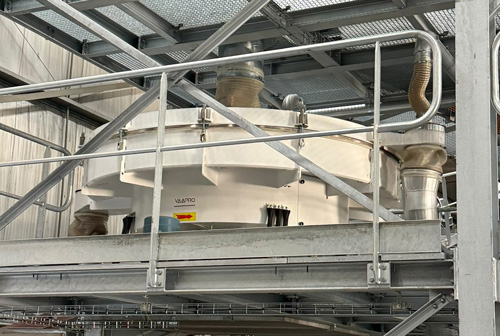 La serie comprende i modelli TVS 1000, 1200, 1600, 2000, 2200 e 2600. La configurazione a più stadi permette di ottenere fino a cinque tagli granulometrici in un solo passaggio; per le applicazioni più fini sono disponibili reti con aperture a partire da 25 micron. I vagli a nutazione TVS sono impiegati nell’industria alimentare e farmaceutica, nella lavorazione delle polveri metalliche, delle materie prime e in altri processi manifatturieri che richiedono la depolverazione o la separazione granulometrica di polveri e granuli secchi.
Continuità operativa, a partire dalla rete
Quando le particelle intasano e occludono le maglie della rete, la superficie utile di vagliatura si riduce. Per contrastare il fenomeno, la gamma prevede sistemi di pulizia a sfere, ultrasuoni, spazzole e getti d’aria. Le parti a contatto con il prodotto possono essere realizzate in acciaio al carbonio, acciaio inox AISI 304 o 316, mentre il sollevamento pneumatico dei piani facilita l’accesso per l’ispezione e il cambio delle reti. La scelta del vaglio, quindi, non parte soltanto dalla dimensione delle particelle da separare: contano anche la fragilità del materiale, la portata richiesta e le esigenze di pulizia della rete. È da questi parametri che si definisce la configurazione più adatta al processo.
TVS tumbler screeners: Precision through controlled motion
Separating particles and preserving the integrity of the product is possible with Vaapro’s TVS tumbler screens that replicate the motion of hand sieving making it adjustable for industrial-scale operation
In industrial screening, separating particles by size is only a part of the process. The other is preserving the integrity of the product, particularly when handling fine powders, friable granules, or lightweight materials. Vaapro’s TVS tumbler screens meet both needs by replicating the motion of hand sieving and making it adjustable for industrial-scale operation.
A motion that guides the material
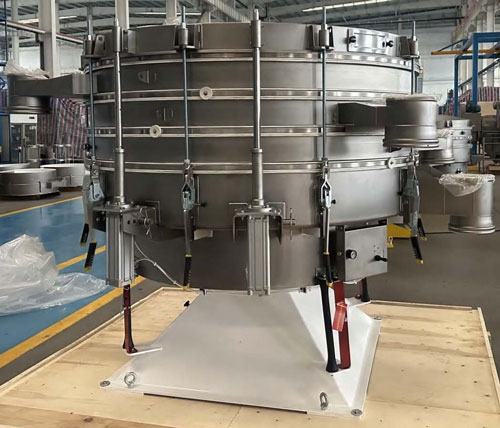 The tumbling action combines a circular oscillation with a slight vertical component. This three-dimensional motion rolls the material across the mesh and distributes it over the screening surface. Adjusting the rotational speed and the angle of the machine body changes how long the material stays on the screen deck. The aim is to give finer particles enough time to reach an opening they can pass through, while limiting the forces on fragile granules. These adjustments help strike a balance between throughput, the precision of the size cut and product integrity.
From dedusting to fine particle classification
The range includes the TVS 1000, 1200, 1600, 2000, 2200 and 2600 models. The multi-deck configuration enables up to five particle-size fractions to be obtained in a single pass; for the finest applications, screen meshes with apertures starting from 25 microns are available. TVS tumbler screeners are used in the food and pharmaceutical industries, in the processing of metal powders and raw materials, and in other manufacturing processes requiring the dedusting or particle-size separation of dry powders and granules.
Keeping the screen clear and accessible
When particles clog and obstruct the mesh openings—a phenomenon known as screen blinding—the effective screening area is reduced. To counteract this, the TVS range offers ball, ultrasonic, brush and air-jet cleaning systems. Parts in contact with the product can be made of carbon steel, AISI 304 or AISI 316 stainless steel, while the pneumatic lifting of the decks facilitates access for inspection and screen replacement. The selection of the screener, therefore, is not based solely on the particle size to be separated: material fragility, required throughput and the mesh cleaning requirements must also be considered. These parameters determine the configuration best suited to the process.